

What Happens to Milk as it is Made Into Cheese?
The chemistry of milk and cheese: how does milk's structure transform into a variety of rich, flavorful dairy products?
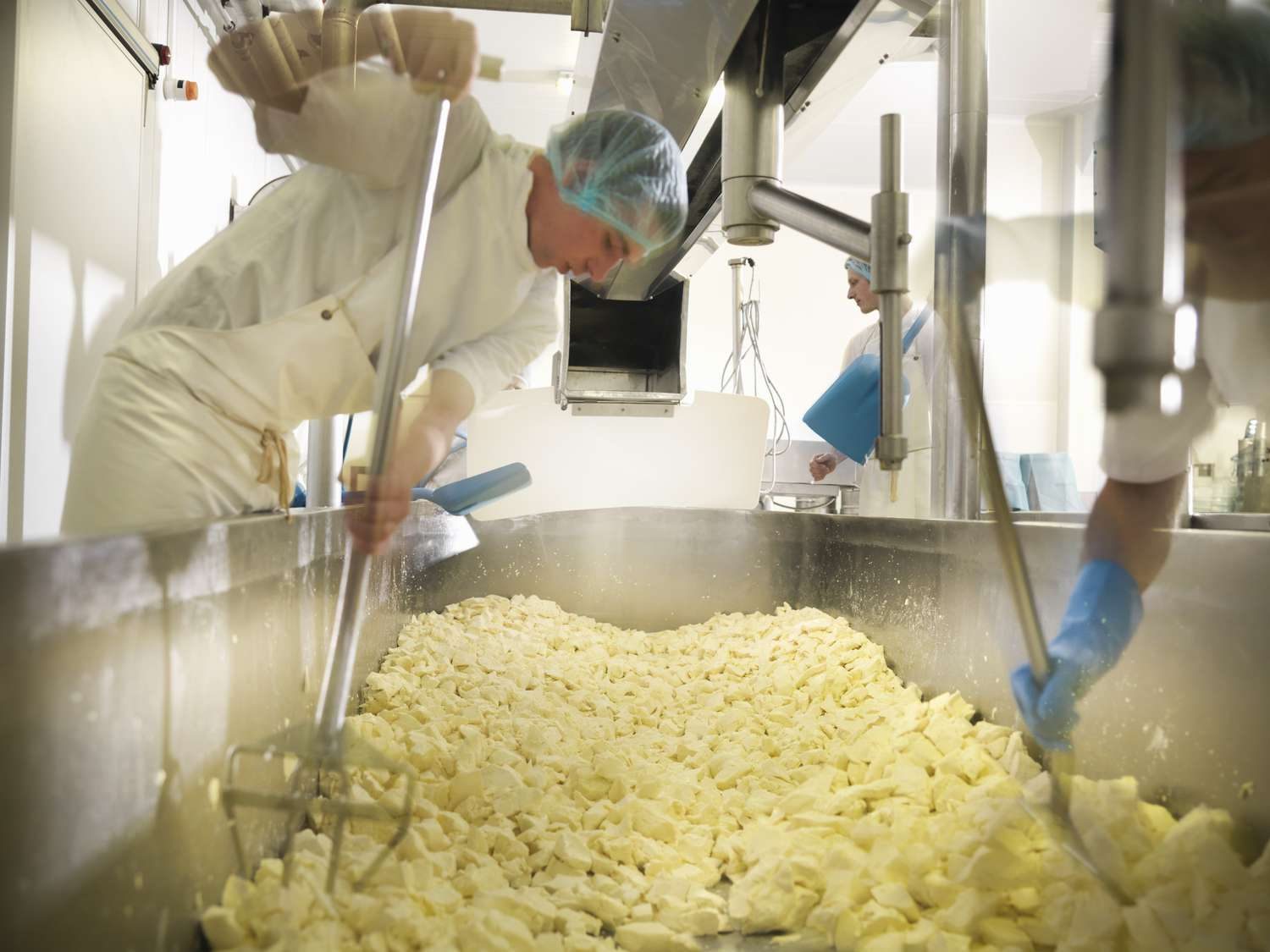
This summer I volunteered at a dairy farm in Belgium. I got to experience the whole dairy farming experience from milking the cows to processing the milk and turning it into cheese, butter and all things in between.
And thus I wanted to know more — not about how to make cheese and butter, but what happens to the literal chemical structure of milk when it is processed.
'Anatomy' of milk
Milk is a suspension, meaning it is a heterogeneous mixture consisting of solid and liquid particles dispersed in a fluid. It is mostly made up of water, some fat, the sugar lactose and proteins such as casein.

Fig. 1: The components of milk
Milk is an energy rich drink. A 244g glass of whole milk contains about 146 calories.
The most prevalent sugar is lactose, which makes up 5% of milk. In our bodies, lactose is broken down by the enzyme lactase into monosaccharides like glucose and galactose.
A good part of milk is also made up of fatty acids. Most of these lipids are found in the form of saturated triglycerides.
Triglycerides are stored inside fat globule membranes (MFGMs), which surround the triglycerides with a triple-layer of phospholipids.

Fig. 2: Milk fat globule (membranes).
About 200 different types of proteins are found in milk. The most abundant is casein, making up about 80% of proteins in cow's milk.
Processing of milk into cheese – Acidification
The first step to making cheese is acidification, where bacteria cultures are added to milk and heated to an adequate temperature. These bacteria turn lactose into lactic acid by fermentation.
The bacteria used varies from cheese type and production method. Bacteria that is used in acidification can be homofermentative (producing only lactic acid) or heterofermentative (producing byproducts alongside lactic acid).
For example, Leuconostoc mesenteroides emits CO2 gas during fermentation, which creates the characteristic holes found in Emmental cheese.

Fig. 4: Glycolysis pathway: conversion of glucose to lactic acid
Step 2 – Coagulation
In the second step, rennet is usually added to the milk. Rennet refers to enzymes (such as chymosin) that turn liquid milk into two parts: the curd and the whey.
Rennet cleaves k-casein, removing the hydrophilic layer. The casein micelle hereby adopts a hydrophobic nature, encouraging casein micelles to conglomerate.
This binding together forms a matrix that traps other molecules such as fat and water inside it — the curd.

Fig. 6: The curd (the white, firm part) and the whey (the 'yellow water' around it).
The following steps
The curds are cut into small pieces for firm cheeses, while bigger curds are used for moist cheeses like brie. The cheese is then salted, molded, pressed and brought into a cellar where temperatures and humidity are closely monitored for aging.
When a cheese ages, the bacteria and acids inside change its flavor and texture. Most importantly, proteolysis — the breakdown of proteins during aging — releases free amino acids and peptides that impart the flavor of the cheese.
Making cheese is like controlling an ecosystem of microbes and bacteria. But chemistry can help us understand processes that go on behind the scenes.
swipe for next article
The 2024 Nobel Prize in Chemistry: A simple explanation
Nobel-winning AlphaFold solves a 50-year mystery, revolutionizing protein structure…
The Underground Highway for Trees' Survival
For the past half century, evidence has been accumulating that trees are not just static…
Why 1+1=2 (And Why It Took 379 Pages to Prove It)
For two millennia, humanity assumed Euclid's geometry axioms were the literal,…
Metal-Organic Frameworks and Yet Another Nobel Prize
Structures that allow for water purification, substance separation, extraction of CO2 out…
What Becomes of Meaning in a Mathematical Universe?
If the universe is a mathematical structure, what happens to human meaning? An…
The Science of Dreams
From REM cycles to emotional granularity: how dreams shape memory, creativity, and the…