

The Science of Dreams
From REM cycles to emotional granularity: how dreams shape memory, creativity, and the way we feel awake.
Sleep and dreams are an essential part of our life. Sleep restores the body, but dreams?
They aren't just elusive stories that play out while you sleep. Have you ever woken up from a nap, sat down to work, and suddenly been flooded with new ideas or a newfound inspiration?
Felt your stress dissipate after a restful sleep? Or had better control over your emotions?
That's not only because of the nap you took but because of the dreams that are unfolding in your mind.
While dreams were attributed to divine forces historically and seen as prophecies, later in the 1900s, Sigmund Freud shifted the views towards psychology, proposing that dreams are reflections of unconscious thoughts, desires and conflicts. Today, modern science makes it a peripheral interest to a wide range of disciplines such as biochemistry, neurology, pharmacology, psychiatry, physiology, psychology, and philosophy.
Neuroscience Of REM Sleep
Stages of sleep include Rapid Eye Movement(REM) and Non-REM phases. During REM phase the eyes dart beneath shut lids, hence the name.
Throughout the night the brain shifts between REM and NREM sleep, with each stage having their unique role. In 1953, the sleep researchers Nathaniel Kleitman and Eugene Aserinsky who are widely recognized as the founders of modern sleep research discovered Rapid Eye Movement (REM).
Their work proved that sleep is not a uniform passive state but consists of distinct, cyclical stages. They discovered that during REM sleep the brain activity would go up and down slowly instead of resting and that the vivid dreaming happens at this stage.
Brain activity scans for NREM and REM sleep
NREM REM = least active = most active
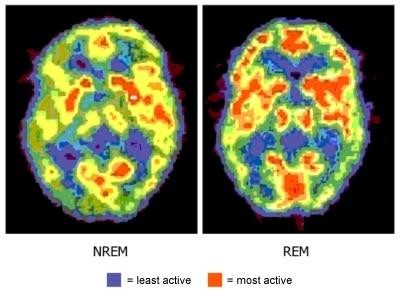
The brain areas involved with long term memory and emotion are highly active during REM sleep. Source – Sleep Health Foundation.
Your body becomes more relaxed during REM sleep, almost paralyzed. Later research revealed that dreams are not exclusive to REM sleep; they also occur during NREM sleep.
In fact, REM sleep does not always contain dreams.
Though dreams occur in both REM and NREM sleep they are distinct. We go through 4 stages of NREM sleep every night before experiencing REM sleep.
- Drowsy State
- Light sleep
- Moderate Sleep
- Deep Sleep / Slow Wave Sleep
The patterns observed in REM and NREM dreams are different based on the observations made by recording brain waves / electrical activity with Electroencephalogram (EEG). And we'll see how it's connected to the brain's anatomy and our complex emotions.
EEG patterns in sleep and wakefulness
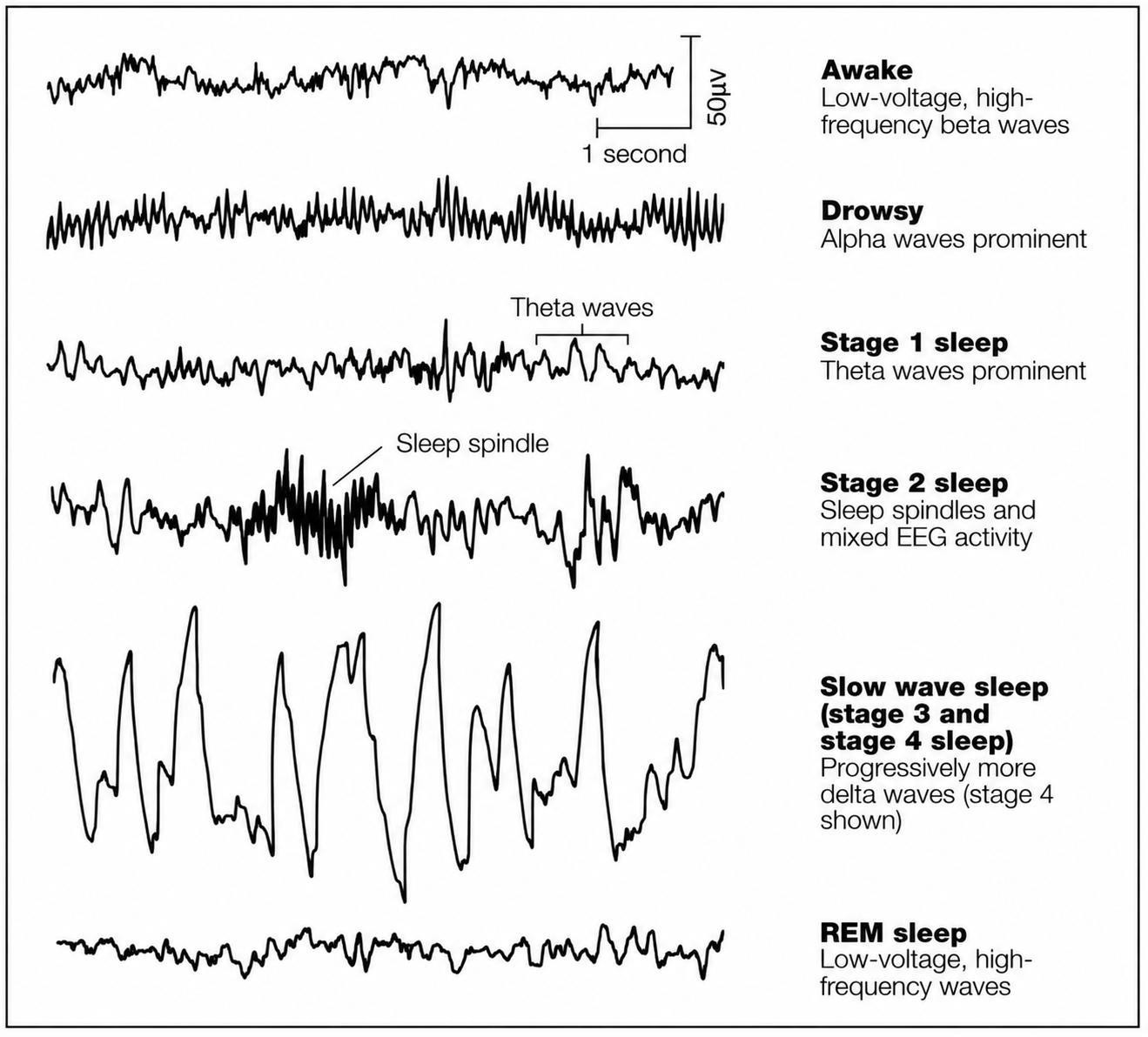
EEG patterns in sleep and wakefulness
Non-REM dreams re-enacts your memories, but as time passes they incorporate other memories. For example, let's imagine that you went to sleep thinking about meeting your friend the next day and having fun, in your sleep you might meet your friend, you both could go to a café, eat your favorite desert, then walk together while catching up to your life and you dream about the things that you have been waiting to tell.
And all this happens in a few seconds to a few minutes. And when you wake up from this dream you would have some sort of idea about what to do and what things to talk about.
So, NREM dreams basically reflect your past memories. In this case you might dream about going to your regular café and ordering your regular coffee.
And these kinds of dreams help you to learn and get new ideas.
Now here is the fun part in REM dreams you may enter a virtual world full of fantasies or horrors. It works as a simulation with vivid details and emotional whirlwind.
Now say you met your friend but in a whole new place that you never went to or know about and then you both get chased by a group of people that you don't know. Or your friend may start saying something emotional which makes you feel nostalgic.
This dream is wild, less logical, intense and rich in vivid sensory experiences compared to a NREM dream, lasting for up to 5-60 minutes. Which improves your memory, creativity, clarity, intuition and emotional response in your wakeful life.
Emotional Granularity And No Dream State
Non-REM dreams are all optimistic and boost the dreamer's self-regard positively while REM dreams tend to be pessimistic making the dreamer feel anxious and depressed. This happens due to Amygdala: A group of neurons that are present in each hemisphere of our brain, responsible for processing and memory of emotions, especially fear, anger and aggression.
Generally everyone falls asleep through Non-REM sleep and then enters REM but people who have severe depression directly go to REM and spend too much time in REM. As a result they deal with a great deal of unpleasant emotions which is depression.
All human emotions, whether pleasant or unpleasant ,should be distinguished rather than generalized as "good" or "bad". This is what Emotional Granurality is: the ability to identify the emotional experiences with high specificity and nuance.
All of this emotional regulation during sleep is done by the brain regions Amygdala, Hippocampus and Medial Prefrontal Cortex together.
- Amygdala: Highly active during REM sleep; processes threat detection and emotional memory encoding.
- Hippocampus: Active during REM; mediates emotional memory processing alongside the amygdala.
- Medial Prefrontal Cortex (mPFC): More active in frequent dream recallers; exerts inhibitory control over amygdala activity, reducing fear expression.
And these regions sometimes stay more active in the REM phase than wakefulness. REM sleep decreases amygdala reactivity to previously encountered emotional experiences, helping us to respond better during anxiety attacks or other experiences that overwhelm our nerves.
"Continuity hypothesis" suggests that dreaming maintains continuity between waking and sleeping emotional life. Which doubles the time of our emotional experiences letting us face challenges better in waking life.
Mark Solms, a psychoanalyst researched about the brain regions essential for dreaming and REM sleep, in his landmark book "The Neuropsychology Of The Dreams"(1997) based on the anatomical study of 361 neurological and neurosurgical patients, he systematically mapped which brain lesions produce which dream disturbances. It was the first study to apply the same rigorous method used for aphasias and apraxias to dreaming.
Solms' most revolutionary finding is proving that dreaming and REM sleep are controlled by different brain mechanisms which demolished the thinking that dreaming is equal to REM sleep. Solms identified that the brain region whose damage causes dream cessation is precisely the pathway of the mesolimbic dopaminergic system; this system drives curiosity, interest, exploration, and goal-directed behaviour.
When this system is damaged, patients lose the ability to dream and simultaneously lose motivated behavior. The patient with such lesions becomes passive, emotionally flat, and apathetic.
Conclusion
Although researchers and philosophers are probing on how dreams work, no one really knows their meaning or purpose. Dreams have been a part of Sapiens ever since the early human civilizations.
In a way we can view them as art that needs to be interpreted as a surrealist painting. Dreams have been responsible for few Nobel prizes and numerous inventions, films, novels and art, serving as a source of inspiration.
They might even inspire you at some point in your life, next time you experience a dream try to interpret it and observe the details for new ideas and inspiration rather than ignoring them.
swipe for next article
Who said it wasn't the wind?
We judge the twisted tree but never the wind that shaped it. An essay on circumstance,…
A Theory on Logic and Science
How is logic supposed to work? And if science is built on logic, what are the…
Do humans have genuine free will, or are our choices just the product of circumstances and character?
The essay explores the question of whether humans possess genuine free will or if our…
Free Will and the Brain: Who Decides First?
We prefer to believe that we are in control. But what if the feeling of choosing is not…
What Becomes of Meaning in a Mathematical Universe?
If the universe is a mathematical structure, what happens to human meaning? An…
What Happens to Milk as it is Made Into Cheese?
The chemistry of milk and cheese: how does milk's structure transform into a variety of…