

The 2024 Nobel Prize in Chemistry: A simple explanation
Nobel-winning AlphaFold solves a 50-year mystery, revolutionizing protein structure prediction for medicine and biotech.
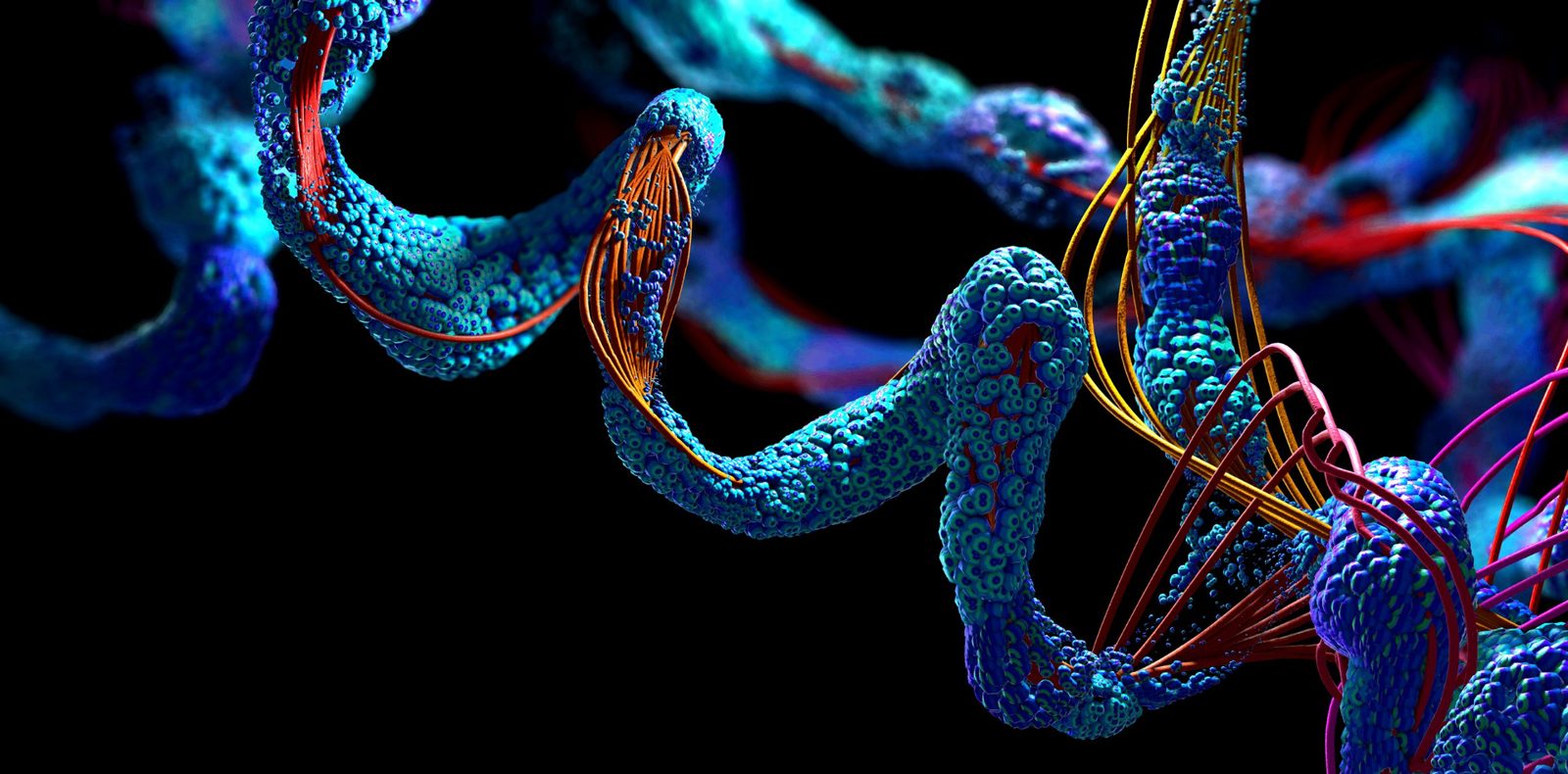
The 2024 Nobel prize in Chemistry went to David Baker, Demis Hassabis and John Jumper, the three men behind cracking the 50-year-old problem of predicting proteins' structures. The following article should help familiarize you with their work and what led them to take this project on.
The world is becoming increasingly curious about complex biostructures. As the World Economic Forum put it: "The biorevolution is kicking off."
Many of the Nobel Prizes awarded in chemistry over the past 20 years were on biochemistry or used chemical knowledge to solve complex biological problems.
Why are protein structures problematic?
Sequences of your DNA 'code' for a specific amino acid. For example the DNA sequence 'UCU' codes for the amino acid serine.
There are around 20 different types of amino acids, each one being a little different from the other.
Amino acids bind to each other and eventually form a protein. Based on how the different amino acids interact with each other, the polypeptide will twist differently.
This polypeptide, arranged in alpha helixes or beta sheets, will fold into a protein which will take on a specific function.
Depending on the sequence of the amino acids, the polypeptide will be coded to have different functions. Polypeptides can have undefined lengths and the amino acids present bond in a random order.
This means that proteins become extremely complex once folded a few times over.
How does AI mix into the Nobel prize for chemistry?
Determining protein structures was often done using X-ray crystallography — the same technique Watson and Crick used to identify the double helix structure of DNA in 1953.
AI has the advantage of needing less code to do more action. It can learn from its mistakes and become very good at something in much less time.
In 1994, CASP was launched (Critical Assessment of Structure Prediction). It was a worldwide experiment working a bit like a competition.
In 2018 a participating group by the name of AlphaFold won CASP13, and then CASP14, with a score of around 90/100.
How AlphaFold works
AlphaFold predicts protein structures by accessing a database of protein structures. It uses Multiple Sequence Alignment (MSA) to compare DNA codes of different species, and pair representation to determine how amino acids interact with each other.
Both the MSA and the pair representation are updated throughout the algorithm — 48 times in total. This is an underlying principle of machine learning: the machine literally 'learns from itself'.
Once a final model has been set up, AlphaFold gives itself a rating (pLDDT score) on how well it determined the position of each amino acid.
Conclusion
Let's hope that programs such as AlphaFold can continue to make breakthroughs in biochemistry. Especially interesting is the study of denatured proteins and mutations which are the cause for diseases such as Alzheimer's or Parkinson's.
AI might really revolutionize the field of genetics.
swipe for next article
The Underground Highway for Trees' Survival
For the past half century, evidence has been accumulating that trees are not just static…
Why 1+1=2 (And Why It Took 379 Pages to Prove It)
For two millennia, humanity assumed Euclid's geometry axioms were the literal,…
Does A Purposeless Universe Equate To Freedom?
As far as the anxious, achievement obsessed 21st century is concerned - nothing ever…
Metal-Organic Frameworks and Yet Another Nobel Prize
Structures that allow for water purification, substance separation, extraction of CO2 out…
What Happens to Milk as it is Made Into Cheese?
The chemistry of milk and cheese: how does milk's structure transform into a variety of…
What Becomes of Meaning in a Mathematical Universe?
If the universe is a mathematical structure, what happens to human meaning? An…