

Who said it wasn't the wind?
We judge the twisted tree but never the wind that shaped it. An essay on circumstance, judgment, and the hidden histories behind human character.
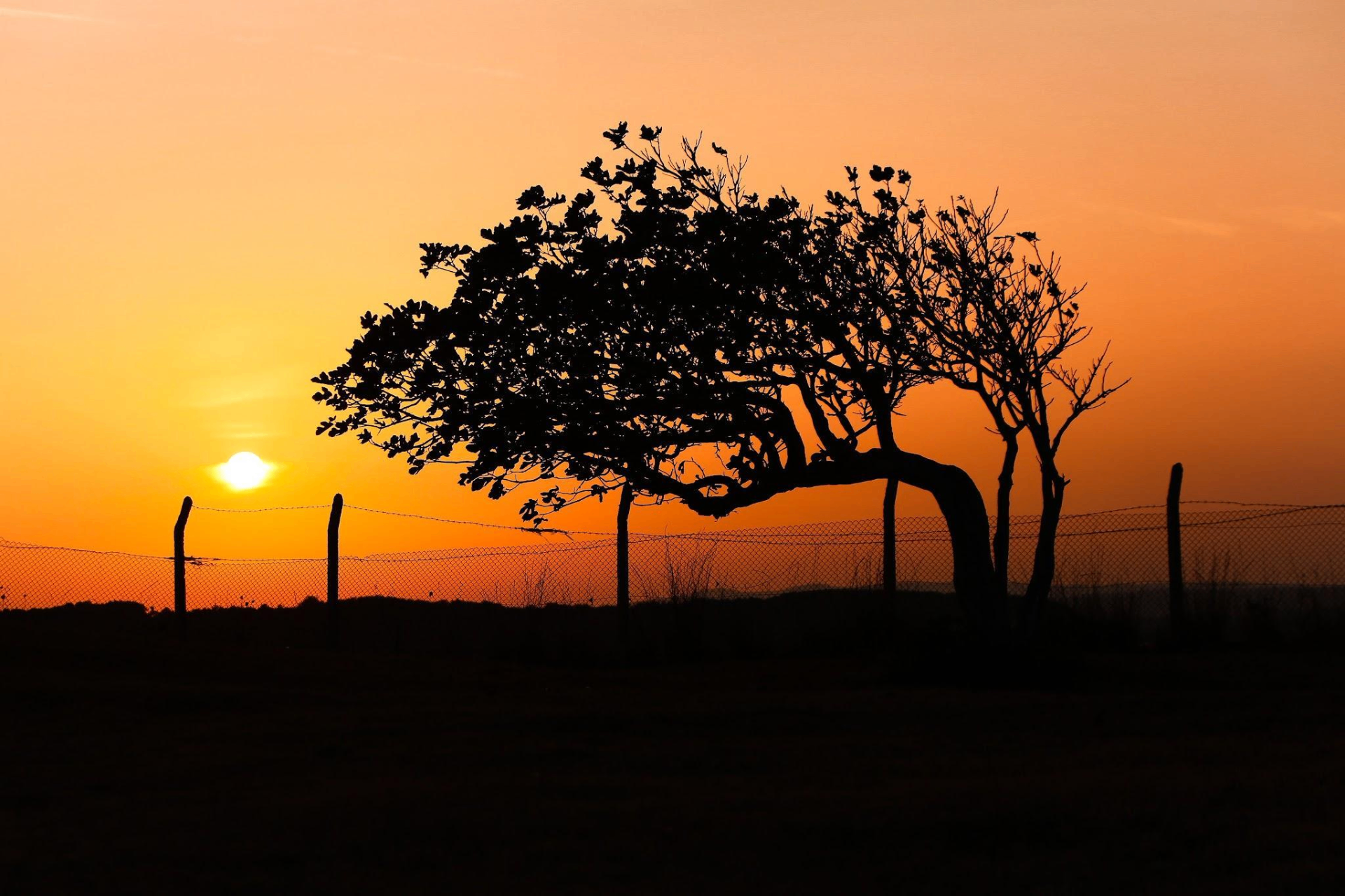
A tree has stood on the edge of a cliff for almost a century.
Every winter the wind pushes it a little closer to the sea. Every spring it leans back toward the sun.
Its trunk twists, curves, and hardens. All that constant pushing and leaning, and now, a despicable bend characterizes that ugly tree.
But is it really the trees' fault that he has such a disfigured silhouette? You see, most of us notice the bend before we notice the wind, and isn't that exactly how human judgment works?
When someone lies, steals, betrays a friend, or commits an act that leaves lasting harm, our attention rushes toward the action itself. We weigh it against an invisible standard and search for certainty in the verdict.
Actions are always obvious, yet the conditions that produced them aren't. That is why I have never been satisfied with the question "How much should someone's life situation affect how we judge them?"
It sounds reasonable, yet it assumes that circumstances do nothing but surround a person, like the weather surrounds a landscape.
But circumstances are not the weather, nor are they like the weather. Circumstances are the landscape.
Trees cannot choose their ground, yet we still admire what they become. The ground determines which roots can spread and how much weight a tree can carry before it bends.
Yet nobody looks at the wind-shaped tree and calls it a moral failure. We study the cliff, the soil, the seasons, the ecosystem.
And often, we admire the result of these natural conditions, calling it resilient. Beautiful, even.
And yet we don't apply the same code of conduct when we judge humans?
When judging humans, we seem to only judge the fruit, all while ignoring the soil.

Figure 1. A tree shaped by decades of prevailing wind.
We naturally explain its form through its environment before judging the tree itself.
Philosophers describe part of this problem as circumstantial luck: the simple observation that none of us choose the conditions in which we begin. We do not choose our parents, our language, our fears, nor our opportunities.
Yet those conditions become the lens through which every later decision is made.
Imagine two children growing up under different conditions. Years later, when they face the same failure, one experiences failure as a "lesson learned" while the other experiences it as a great, dramatic danger.
Outwardly, nothing is different: a failure is a failure after all. Yet inwardly, they are living inside entirely different worlds.
Chaos theory reminds us that tiny differences at the beginning can produce dramatically different outcomes over time. And human lives often unfold the same way.
An encouraging teacher, an absent parent, a few years of poverty, a single unexpected kindness: none seem decisive in isolation. Yet years later those small differences become habits, feelings, and eventually a little something called personality.
Our judgments have blind spots too.
Psychologists even have a name for one of these blind spots: the fundamental attribution error. We explain other people's actions through character while explaining our own through circumstance.
If someone cuts us off in traffic, we call them reckless. Yet if we do it ourselves, all of a sudden the only thing of relevance is the emergency that made us late.
Thus, we instinctively tell stories about ourselves, but tell summaries about everyone else. We aren't ever the objective, outsider judges we like to think we are.
The judge, it turns out, is standing in the same wind as the tree.

Figure 2. Tiny differences in initial conditions can lead to vastly different paths over time.
Looking into the brain itself, neuroscientists have shown that repeated experiences gradually reshape the brain itself. That effectively means no mind reasons in an empty space.
Nop, every thought is assembled from material gathered somewhere.
For most of history that material came from families, neighborhoods, schools, and communities. Today it increasingly arrives through screens.
Algorithms quickly influence what we encounter, and by being shown the same content over and over, repetition turns into familiarity... And familiarity becomes normal...
And normal becomes truth. If our perception is shaped by the worlds we repeatedly inhabit, then judgment requires humility more than certainty.
So, before asking why someone reached the wrong conclusion and egged your car, or yelled at you, it may be worth asking what kind of world made that conclusion appear reasonable to them. Perhaps TikTok convinced your friend egging cars was cool, and maybe they got convinced because they're desperate for some peer approval.
This doesn't mean you can't judge them for egging your house, but it does make writing judgment off as "certainty" more penalizable.

Figure 3. Repeated experiences physically reshape neural pathways—a process known as neuroplasticity.
Here's the thing: you don't need crystal clear understanding to install a verdict on someone. What justice requires is remembering that every one of those loud, annoying action carries a more hidden, invisible history.
So, when I think again of the tree standing on the cliff, I no longer see only its twisted trunk. I see his interactions with the wind.
The tree still bears the weight of its branches, but the wind has left its signature on every one of them.
We place the tree on trial while the wind never enters the courtroom of our judgments. It bends and twists the tree, and yet it receives no sentence?
The wind goes unnoticed, because the tree never argued with the wind. The only "visible" crime is the bend, and the tree is judged solely on that because it never fought the wind.
The tree simply grew around it.
And the same thing applies to us human beings: a human is judged on what they turned out to be, yet what made them that way is rarely judged.
We often imagine character as something built from within. And yet, surprisingly, more often it is something negotiated with the world.
swipe for next article
A Theory on Logic and Science
How is logic supposed to work? And if science is built on logic, what are the…
Do humans have genuine free will, or are our choices just the product of circumstances and character?
The essay explores the question of whether humans possess genuine free will or if our…
What Becomes of Meaning in a Mathematical Universe?
If the universe is a mathematical structure, what happens to human meaning? An…
Equality and democracy
Can we quantify or determine the value of a human being without being arbitrary?
The 2024 Nobel Prize in Chemistry: A simple explanation
Nobel-winning AlphaFold solves a 50-year mystery, revolutionizing protein structure…
An Abstracted Reality: How your mind creates your own unique lifeworld
Nobody but yourself will know the full scale of thoughts lingering in your own head.