

An Abstracted Reality: How your mind creates your own unique lifeworld
Nobody but yourself will know the full scale of thoughts lingering in your own head.
Nobody but yourself will know the full scale of thoughts lingering in your own head. Parents, friends and lovers all have unique versions of you.
However, their versions will never be completely certain. It's impossible to access each other's consciousness and therefore impossible to know who you really are.
The same applies to other people's minds. How can I know they are conscious?
This view of course can be challenged. Yes, we lack direct access to other's minds, but we still share external experiences and can relate to each other.
Humans are after all, social animals.
Nonetheless, even our own experience of external circumstances can be challenged. Our perception of reality is a translation given to the brain by receptors detecting external stimuli.
There are several of them. Take the receptors called nociceptors, they are responsible for translating mechanical, chemical or thermal damage into electrical signals perceived by the brain as pain.
Or chemoreceptors, they are responsible for translating chemical properties into electrical signals which are later perceived as smell and taste. It's hard to tell how accurate the brain's translation of external circumstances is but given that we as humans can use these electrical signals to survive, shows a certain reliability to our perception of reality.
This means that our way of seeing the world is not the only one. Neither is it static.
*
Science follows a similar pattern. The theories of electromagnetism for example, has like all other scientific theories, a continuous development.
Faraday was the experimentalist who opened the field of electromagnetism. Through trial and error, he showed that electricity can produce mechanical motion, a changing magnetic field creates an electric current and that magnetic fields emerge when sprinkling iron around a magnet.
When Faraday published his theories about magnetic lines of forces, people did not directly accept them. The 1900-century was not a period where the science community believed in "invisible lines of forces".
The industrial revolution had completely changed human civilization, and invisible forces didn't have a place in this modern world.
However, through practical usefulness, Faraday's theories have stood the test of time.
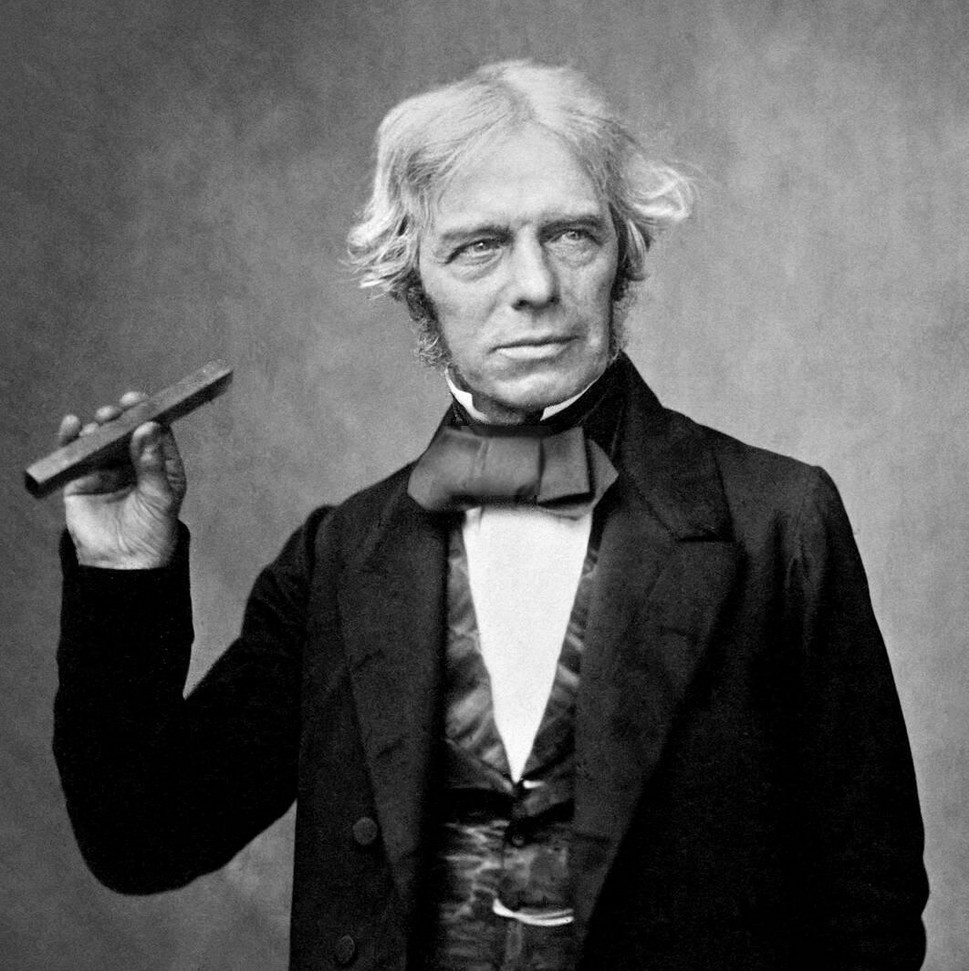
Michael Faraday holding a piece of glass used in one of his experiments. Photo taken in 1857.
Source: https://en.wikipedia.
org/wiki/Faraday_effect
I can understand why scientific theories about electricity weren't accepted. For our senses, it's invisible.
"Any sufficiently advanced technology is indistinguishable from magic." (Clarke's Third law)
Human existence is dependent on meaning and structure to survive. One does not accept what he cannot understand.
This can be understood from a biological point of view. Meaning and structure is necessary for a species to plan and adapt to an uncertain future.
For the species survival this is a huge advantage. Gathering enough information to know where and when food is available is a good example.
Science can be seen as an extension to this human necessity. Well established theories provide the structure necessary to evolve as a species.
It makes it possible to predict future events and use limited resources in the most effective way.
However, science is built on assumptions. A work of man, perceived by his limited brain.
According to Karl Popper, a highly regarded Austrian philosopher, knowledge can never become the complete truth. In Logik der Forschung (1934) Popper argues that any scientific theory can never be completely certain.
No matter how much it has evolved. The same can be said will be true in 100 or even 1000 years.
Because if I state that for example "all swans are white", and I count to 10 000 white swans, how will I know that the next is also white? One black swan is enough to falsify the current statement.
Science is reaching for that complete scientific truth. I imagine it like an athlete running towards a finish line but never reaching that line.
Nonetheless, the athlete has after some time ran several hundreds of kilometers. The "kilometers" or knowledge gathered is still real.
Faraday's electrical fields had nonpractical usefulness at its beginning, and he had to rely on intuition to work with "invisible lines". Still, what he started gave all the next generations the chance to build upon his statements and hence invent all the digital inventions of today.
"If I have seen further, it is by standing on the shoulders of giants." - Isaac Newton
What distinguishes us from other animals is the ability to create an abstract reality. Our brain can create ideas that are derived from the external world but are in a higher cognitive layer.
The "neo cortex" (the outermost layer of the brain) is responsible for our cognitive abilities. There, we perceive reality as nations, brands, religions, science… All creations of the human mind.
This essay is highly motivated by the writings of Lucian Delacroix on "A theory on Logic and Science". An attentive reader might notice some similarity between them.
However, it's not my intent to write about the same ideas. This essay explores similar topics with hopefully new and fresh insights given to the reader.
swipe for next article
The Paradox of Consciousness
On the difference between the existence of experience and the capacity to recognize it —…
The Science of Dreams
From REM cycles to emotional granularity: how dreams shape memory, creativity, and the…
Who said it wasn't the wind?
We judge the twisted tree but never the wind that shaped it. An essay on circumstance,…
A Theory on Logic and Science
How is logic supposed to work? And if science is built on logic, what are the…
What Becomes of Meaning in a Mathematical Universe?
If the universe is a mathematical structure, what happens to human meaning? An…
What was unique about the Nobel prize in Physics 2025?
Normally, balls don't fly through walls. However, quantum particles do. Find out how 3…