

What was unique about the Nobel prize in Physics 2025?
Normally, balls don't fly through walls. However, quantum particles do. Find out how 3 people won the Nobel Prize.
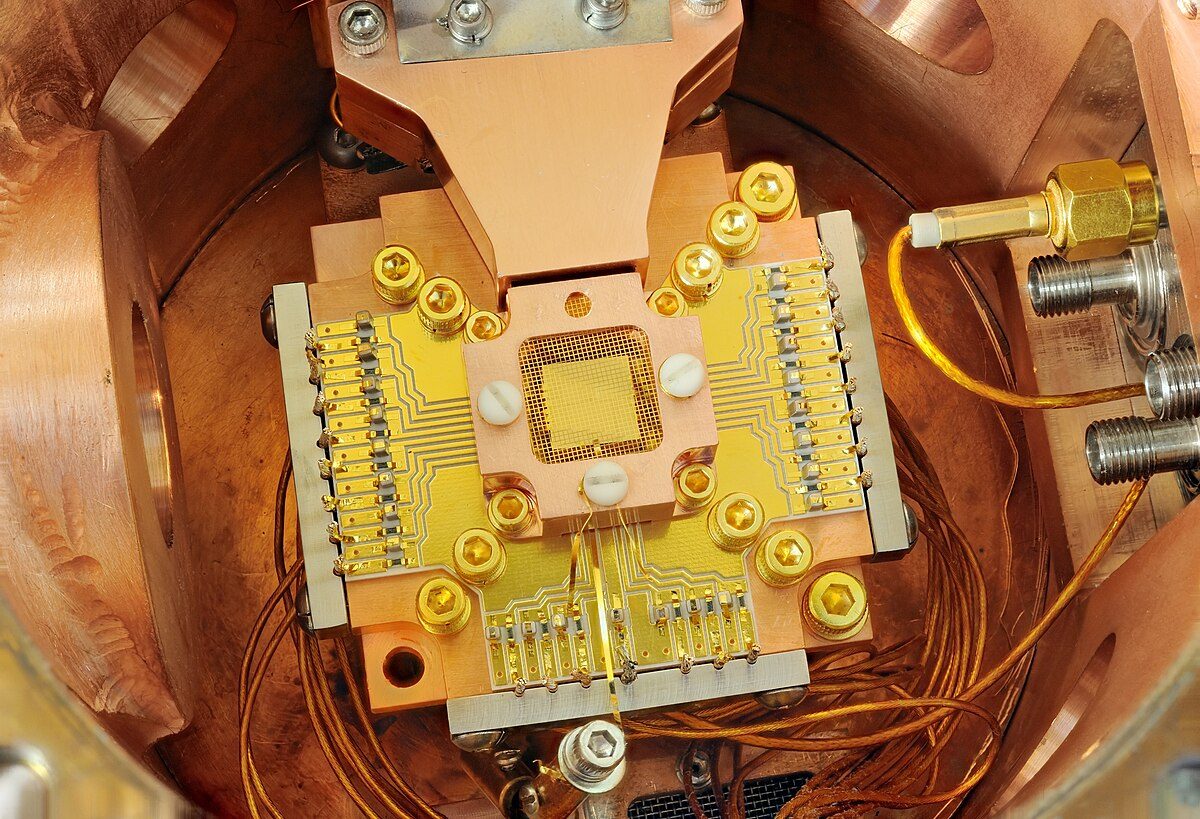
The Nobel Prize in Chemistry isn't the only Nobel prize that has been awarded this October. Perhaps one of the most interesting awards has been given to John Clarke, Michel Devoret and John Martinis for their work on quantum tunneling.
When they worked on this in the 1980's, quantum physics was seen as a very abstract and highly theoretical discipline. With their research, the Nobel laureates showed that quantum physics could also be observed in a macroscopic system.
A brief introduction to quantum mechanics
John Dalton gave one of the first descriptions of the atom in 1804. He hypothesized that atoms were the smallest quantity that made up everything and couldn't be divided.
Yet only 100 years later, the atom was split.
Theories change over time, and so do the applications we can derive from them. One of the most notable advancements in atom theory has been quantum mechanics.
It describes electrons not just as negatively charged dots that can move between shells. Rather, electrons don't have a set position, they are described as having a probability of being at a certain location at a certain time.
Probability and Wave Functions
So what dictates the probability of finding an electron in a certain location? Quantum mechanics describes electrons as waves, just like classical physics describes water or sound waves.
So electrons are described by a wave function Ψ, in particular one that satisfies the Schrödinger equation.
Quantum Tunneling
According to classic physics, throwing a ball at a wall will make it bounce back. Though with extremely small particles, quantum physics says that particles with not enough energy could actually still bypass the "wall" instead of bouncing back.
Quantum mechanics calls this wall a potential barrier. If we take the wave function described earlier and place it against a barrier, we can observe that part of the function still exists beyond the barrier.
This means that there is a small probability of an electron existing outside the barrier.
The Experiment
Clarke, Devoret and Martinis built an electric circuit where they could observe particles' qualities. This circuit consisted of two superconductors with a non-conducting material placed between them, known as a Josephson Junction.
A conductor is any material that allows electrons to pass through it. Consequently a superconductor is a material that acts as a conductor, but poses no resistance to the moving electrons.
Subsequently a non-conductive material, an insulator, is put between these two superconductors. Due to quantum tunneling, some of the electrons in the superconductors can tunnel through the insulator.
This is known as the Josephson effect.
Theory against the Universe?
The Nobel laureates used this junction to investigate the properties of their current. Because the electrons were flowing through a superconductor as joint Cooper pairs, they behaved like a single quantum entity — described with a single wave function.
What made this experiment Nobel prize-worthy was that the laureates increased the current in this system until observing the appearance of a voltage. This was unexpected, as cooper-pairs are typically in a zero-voltage state.
The only explanation was that the wave function of the entire system is tunneling through the insulator, not just the individual electron pairs.
Setting the tone for quantum computing
Thanks to this experiment, quantum behavior was observed on a larger scale for the first time. Considering it was carried out in the 1980's, when quantum mechanics' applications weren't clear yet, is remarkable.
It set the tone for many of the technologies we are working on today, like quantum computing.
swipe for next article
Metal-Organic Frameworks and Yet Another Nobel Prize
Structures that allow for water purification, substance separation, extraction of CO2 out…
Everything In the World Can Be Simplified Into Its Smallest Components
I've eaten my grandmother's cookies immeasurably often, and so, being curious, I…
What Happens to Milk as it is Made Into Cheese?
The chemistry of milk and cheese: how does milk's structure transform into a variety of…
The 2024 Nobel Prize in Chemistry: A simple explanation
Nobel-winning AlphaFold solves a 50-year mystery, revolutionizing protein structure…
An Abstracted Reality: How your mind creates your own unique lifeworld
Nobody but yourself will know the full scale of thoughts lingering in your own head.
The Paradox of Consciousness
On the difference between the existence of experience and the capacity to recognize it —…