

A Case for Cosmic Silence: Where is Everybody?
If the universe is ridiculously huge, so must be the chances of life. So where is everybody?
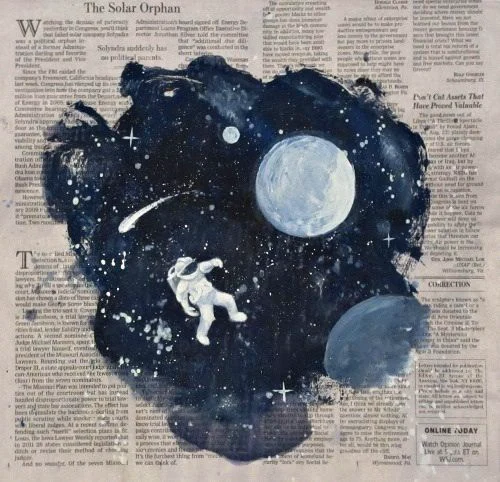
The clock ticks away, late at night. No one is around.
However, there is a slight suspicion creeping on your sleep-deprived intuition that your family might be awake, but you have no way of checking outright without landing yourself in trouble.
Determined to find out, you might seek out other methods of confirmation. It might go like this: checking if their lights are on, or the distinct creaking of a worn-out floorboard.
Your mother might have the same concerns as you.
She, too, may suspect that someone else is awake. Not very dissimilar to you, she may be listening for signs while avoiding drawing attention to herself.
In the absence of certainty, every piece of evidence becomes significant. Silence itself begins to feel suspicious for reasons inexplicable.
Humanity has faced this dilemma for centuries. In our efforts to contact extraterrestrial beings, most have been to no avail.
The tape fixed onto Voyager 1 and its sister ship, Voyager 2, containing tracks from Bach to numerical formulas to greetings in 55 languages. The radio signals transmitted have not received anything back.
Have they been intentionally ignored by possible neighbours lurking, or is it something much more unremarkable?
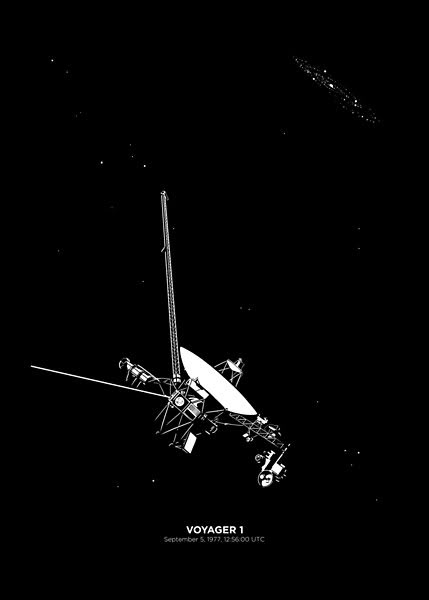
voyager 1
If our planet is but a part of innumerable others, and we still remain isolated; is it because of a lack of reach attained or are there other possible explanations to it?
The Fermi Paradox
The Merriam-Webster dictionary defines a paradox as- ‘an argument that apparently derives self-contradictory conclusions by valid deduction from acceptable premises ‘. In astrophysics, there are many such paradoxes.
One of the most discussed is the Fermi Paradox.
Proposed by physicist Enrico Fermi over lunch in 1950 (“Where is everybody?”) The main core of the paradox was created by many other scientists, most prominently Michael Hart in 1975.
It questions our isolation in the universe. If the universe is ridiculously huge, so must be the chances of similar circumstances of life.
At first glance, the existence of intelligent life beyond Earth seems plausible. The observable universe contains hundreds of billions of galaxies, each containing a myriad of stars and solar systems like our own.
In 2016, astronomers Adam Frank and Woodruff Sullivan used a modified form of the Drake Equation to estimate the likelihood of technological civilizations emerging elsewhere in the universe. Their analysis indicated that humanity would be exceptional only if the chance of a technological species emerging on a habitable planet was exceedingly low, below one in ten billion trillion.
Considering these probabilities, the noticeable lack of alien civilizations grows more intriguing.
This is what forms the basis of the Fermi Paradox. If it is so unlikely for life on earth to be considered ‘rare’, where are the noticeable ticks of life existing elsewhere?
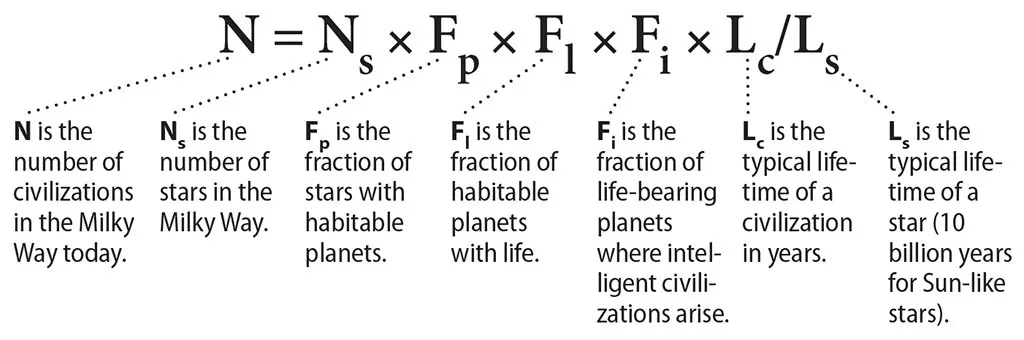
The drake equation
Attempts to estimate the prevalence of extraterrestrial civilizations often rely on the Drake Equation, first suggested by Frank Drake in 1961. Rather than providing a definitive answer, the equation serves as a framework for considering the astronomical and biological factors that may influence the emergence of intelligent life.
The Dark Forest Hypothesis
Imagine two civilisations. There is no rational way of predicting the behaviour without evidence or patterns.
For all we know, they could be very well ahead of us, or on the other hand, in their primitive stages of development.
Civilisation A does not know the intentions of the other, and vice-versa. Even if both are peaceful, there is no way of proving it.
If one civilization misjudges the intentions of another, the potential cost may far outweigh the rewards of successful contact. The toll of risking extinction is greater than the favorable outcome.
Therefore, caution is practiced.
In the novel by Liu Cixuin, ‘The Dark Forest’, the author proposes an axiom that aims to explain the paradox.
For life to remain, it must persist. Survival is what drives a civilization.
To live is above other pursuits and endeavors, such as constituting association. This defeats the purpose of survival, as it poses potential eradication and thus, not initiating contact is the best option for ensuring safety.
There are far too many variables to consider. To put it simply, initiating contact poses a virtually higher chance of risk than remaining silent and not interacting with unknown entities.
Hobbes's State of Nature
In Leviathan, Thomas Hobbes describes the theoretical situation known as the "state of nature," in which there is no shared authority to maintain order.
Contrary to popular belief, Hobbes argued that long-term cooperation is hampered by uncertainty about the motivations of others rather than suggesting that humans are naturally aggressive. Since no institution can ensure their safety, people must prioritize their own survival.
Even among people who would ordinarily favor peace, this mutual mistrust might ultimately result in conflict. Hobbes suggested creating a sovereign authority that could uphold stability and enforce laws in order to solve this problem.
Although no such authority is present on an interstellar level, the idea offers a unique perspective for analyzing the Dark Forest Hypothesis. In a cosmos lacking any predominant authority, societies might experience a situation reminiscent of Hobbes's state of nature.
Conclusion
I believe that both theories are technically plausible explanations of the paradox. The axioms stated in the Dark Forest Hypothesis closely resemble Hobbes's State of nature.
I think the theories are equally as applicable to humanity as they are to extraterrestrial beings since all life, even if vastly different, ultimately has the same purpose.
The universe will remain silent, and I think to assume it might be because of danger, indifference or simply nothing at all are acceptable explanations. Until a response arrives, humanity will not yield.
It is safe to assume that we will not yield. Instead, we will watch, as a sleepless observer.
swipe for next article
Does A Purposeless Universe Equate To Freedom?
As far as the anxious, achievement obsessed 21st century is concerned - nothing ever…
Why is the Night Sky Becoming Harder to See?
The night sky has inspired navigation and discovery. Yet, nowadays it's hardly visible…
A Theory on Logic and Science
How is logic supposed to work? And if science is built on logic, what are the…
Do humans have genuine free will, or are our choices just the product of circumstances and character?
The essay explores the question of whether humans possess genuine free will or if our…
Equality and democracy
Can we quantify or determine the value of a human being without being arbitrary?
Why 1+1=2 (And Why It Took 379 Pages to Prove It)
For two millennia, humanity assumed Euclid's geometry axioms were the literal,…